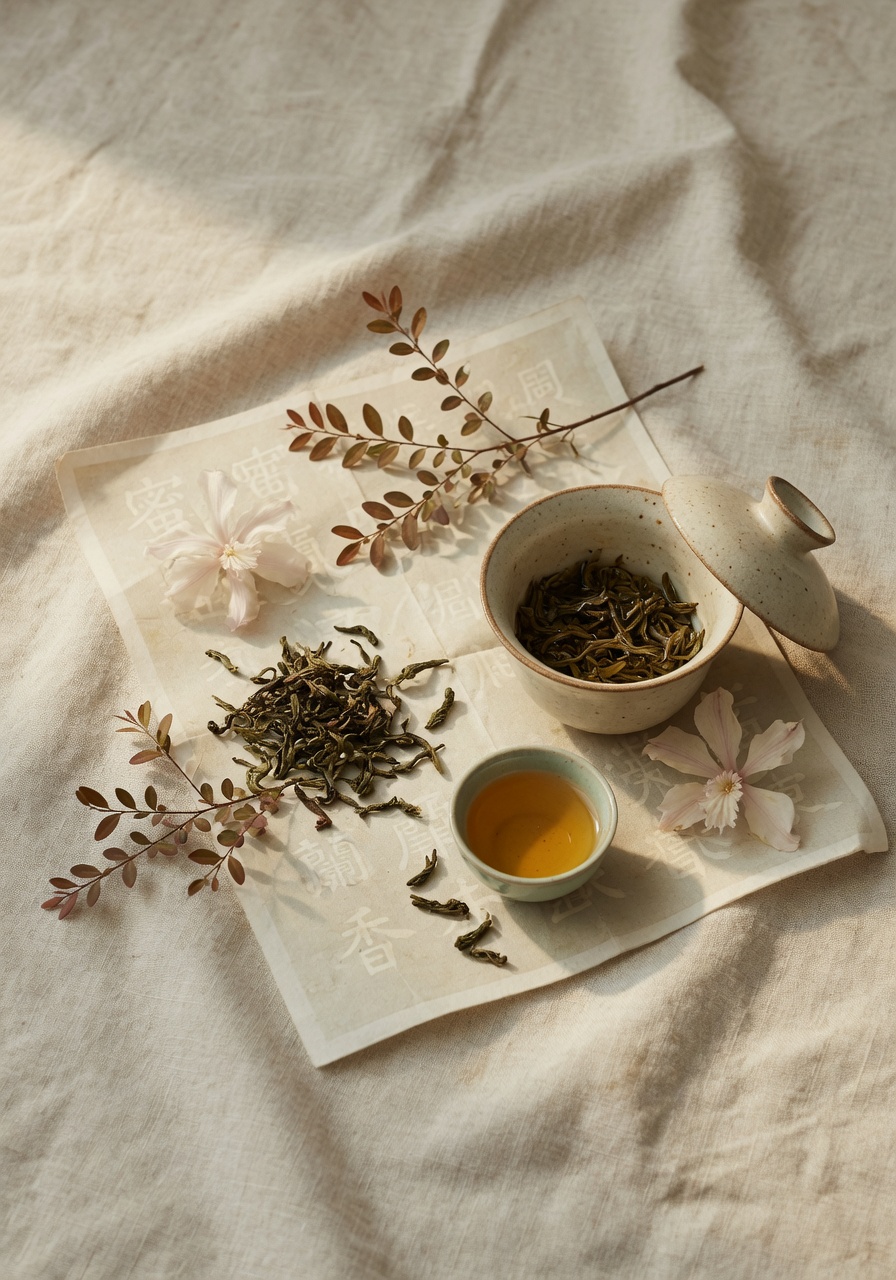
Chen Hui Yi sourced this lot from a small family garden on the lower slopes of Wudong shan, Fenghuang township, at around 980 metres. Although Hui Yi is best known across the constellation for white tea, she keeps a working relationship with three Guangdong oolong families she grew up trading with — and once a year she brings a small dancong lot onto tea.gratis as a sampling drop, so newcomers can meet the Phoenix style before committing to a full tin.
The bush is roughly sixty years old — not an ancient tree, but old enough to push concentrated aromatics and the deep root-draw that gives Mi Lan Xiang its weight. Picking happened in the third week of April 2026, after a dry spell that the family said sharpened the orchid note. Leaves were sun-withered on bamboo trays for about ninety minutes, then carried indoors for two nights of slow rocking — the rounds of bruising and resting that build dancong’s signature fruit-and-flower complexity.
Kill-green was done in a small drum that afternoon, followed by hand-rolling into the long twisted strip shape. The lot then rested for six weeks before its first charcoal bake, and another four weeks before a second, lighter pass. The result is a medium-baked dancong — fruit-forward, with the bake supporting rather than dominating.
Hui Yi has flagged this as a good first dancong for anyone whose palate is used to greens or whites: the bake is gentle, the bitterness is controlled, and the huí gān is unmistakable.
The leaf, brewed
Honey-orchid over warm stone, with a cool throat-return.
dry leaf
Long, twisted dark olive strips — toasted almond and dried lychee skin on the dry sniff.
wet leaf
After the rinse, leaves open coppery at the edges, releasing gardenia and warm honeycomb.
liquor
Bright amber, gold at the rim, fully transparent — no haze even on the fourth pour.
aroma
Lychee honey, white peach skin, a thread of orchid; the bake sits underneath, not on top.
taste
Round and oily across the tongue — ripe nectarine, lychee syrup, a mineral edge by steep three. No astringency when timed.
finish
Cool sweetness returns at the soft palate after twenty seconds — the classic dancong huí gān.
Brewing
A method, not a recipe.
Method
gongfu
Ratio
5g / 100ml
Water temp
95–98°C
First infusion
8s after a 3s rinse
Subsequent
8 infusions — add 3–5s each pour from steep three onward
Use a thin-walled gaiwan, not clay — dancong aromatics get muffled in porous ware. Pour high, decant fully.
CH
Sourced by
Chen Hui Yi
Senior Tea Expert (White, Green & Yellow Tea Varieties)