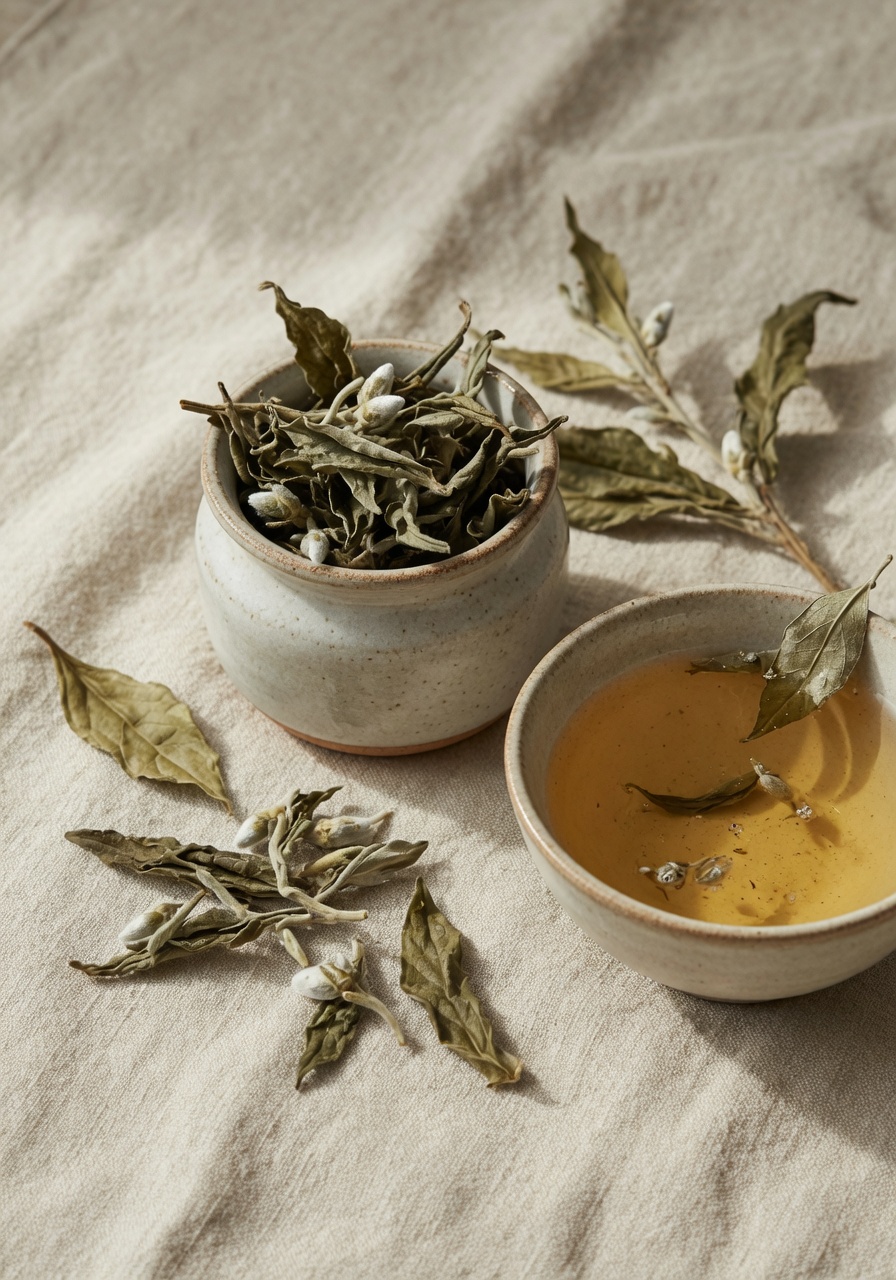
The grade her grandmother kept for winter
Chen Hui Yi’s first tea memory is a clay jar of aged Shòu Méi on a shelf above the rice — opened for stomach complaints, for guests, for cold nights. Long before she trained in sun-withering Yín Zhēn, this was the leaf she knew. Shou Mei is the last grade cut from the spring flush: once the bud-only pickings for Silver Needle and the bud-and-two-leaf sets for Bai Mu Dan have been taken, what remains — the third and fourth leaves, thicker, greener, carrying more stem — becomes Shou Mei. It is the least precious white tea by picking standard, and by most measures the most forgiving to brew and the most rewarding to age.
This lot comes from the same Diantou-area hillside at 680m that supplies Hui Yi’s Bai Mu Dan and Silver Needle sourcing, picked in the back half of the spring window in mid-April 2026, once the finer grades had already gone to their own baskets. Because the leaf carries more mass and more stem than a bud-only pick, the sun-wither runs longer — 48 to 60 hours outdoors on bamboo trays, turned by hand, with no panning and no rolling at any stage. That patience is the entire process: the leaf loses moisture on its own schedule, and the maker’s only job is to read the weather and move the trays.
The result in the cup is broader and less floral than Yín Zhēn, closer in body to a light oolong — dried apricot, wild honey, a mineral thread from the same granite soil, and almost no astringency despite the coarser leaf. Unlike the bud grades, Shou Mei is built to age: pressed loosely into cakes or left loose in a sealed tin, a few years of rest deepen the honey into something closer to dried date, which is exactly the character Hui Yi remembers from her grandmother’s jar. Drink this 5g sample fresh to taste the spring it was picked, or set half of it aside and compare it again next winter.